UX Design
Planet Pals
A mobile app that monitors and tracks users’ daily habits related to waste, energy use, and consumption.
Role:
UX Designer
Team:
Jackie Nam Minami Matsumoto Sneha Yalavarti
Timeline:
24 Hours
Tools:
Figma Figma Make
Figma Figma Make
Figma Figma Make
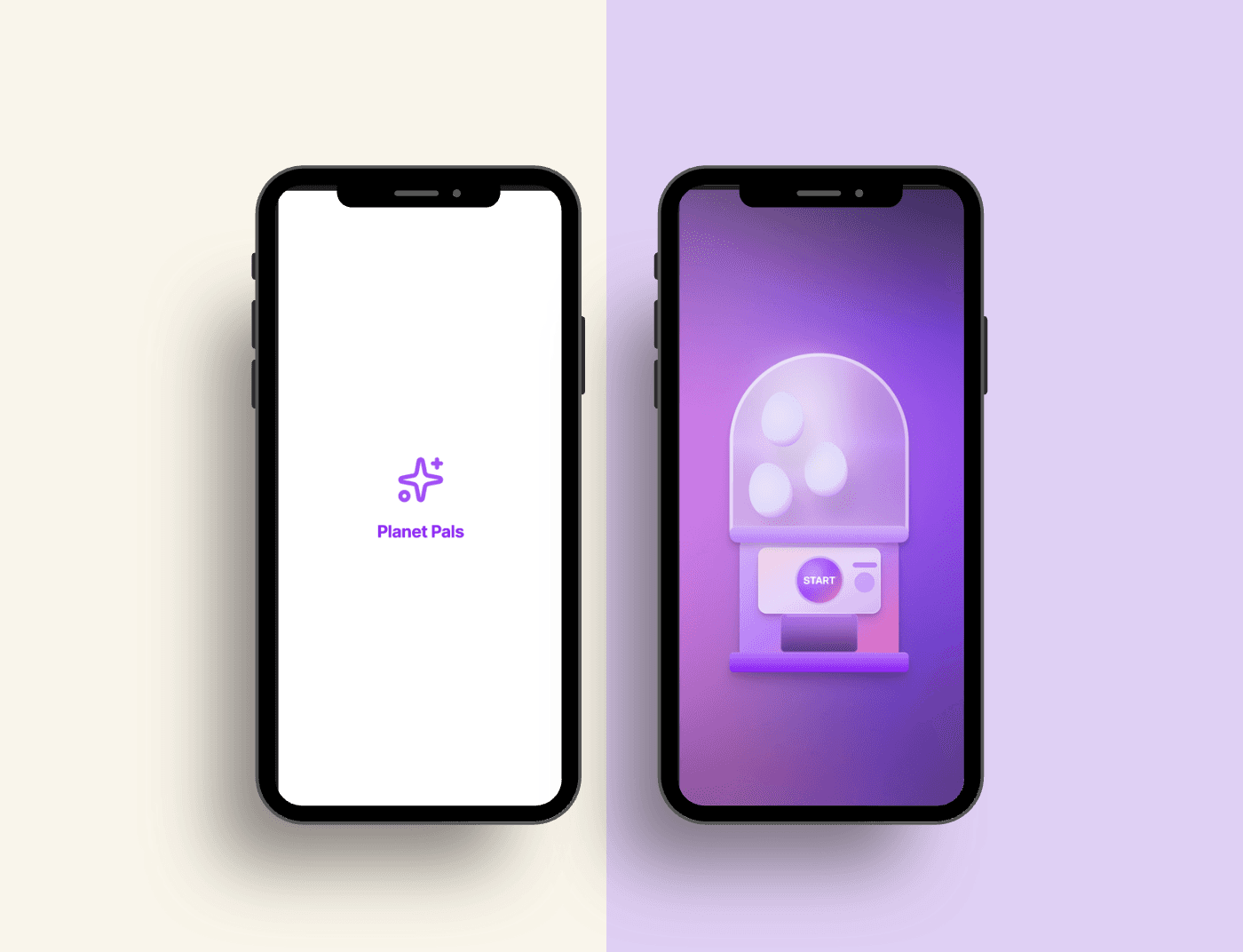
Overview
Overview
Overview
Challenge
Our team was challenged to design an AI-powered mobile app that helps users make more sustainable lifestyle choices, not by overwhelming them with data, but by offering personalized guidance. The experience needed to clearly demonstrate how AI could interpret user behavior, evolve recommendations over time, and motivate long-term environmental impact.
INSIGHT
We recognized a crucial gap between users’ intent to live sustainably and their ability to act on it. Environmental responsibility often feels overwhelming, abstract, or disconnected from daily life. To bridge that, we turned to models like Duolingo and Tamagotchi → tools that succeed by being fun, emotionally resonant, and focused on small, repeatable action.
Solution
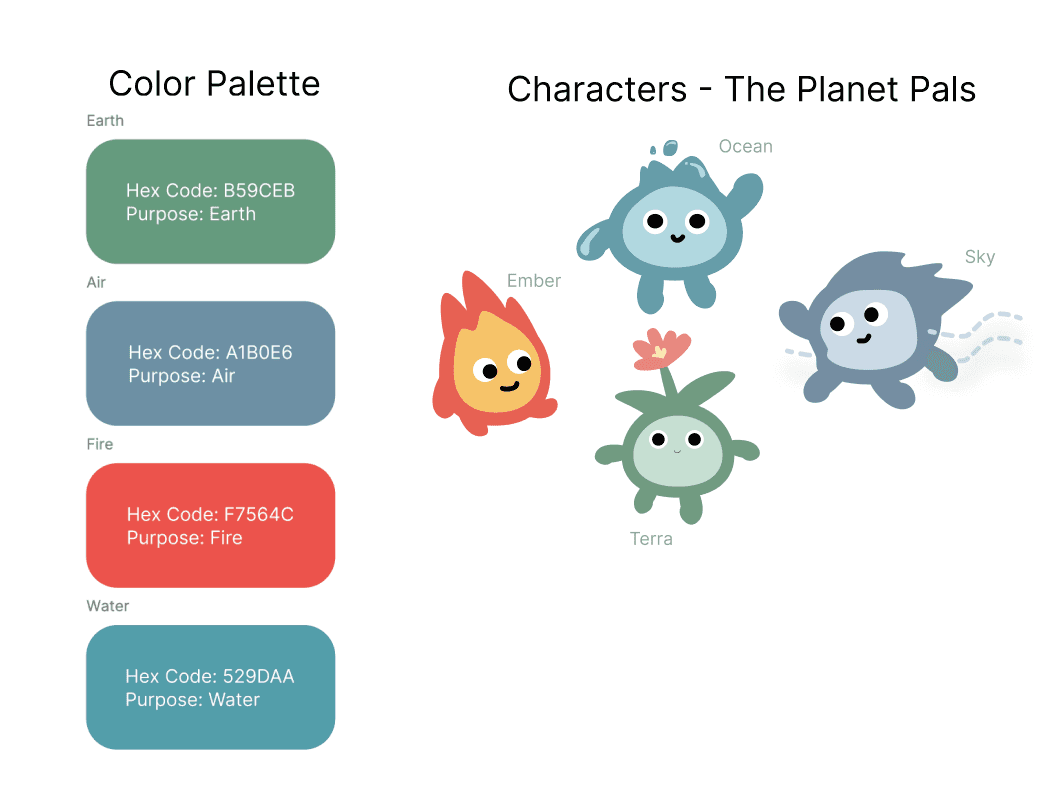
Planet Pals transforms sustainability into a personal quest. Users begin by taking a personality quiz that determines their elemental companion, a gamified character tied to one of four global threats: fire, air, land, or water. To nurture their creature, users complete small, sustainable actions tailored to their own habits and lifestyle. With AI-driven progress tracking, adaptive task suggestions, and monthly insight reports, the app helps users see—and feel—the long-term impact of their choices.
PROCESS
Approach & Prioritization
With only 24 hours to bring Planet Pals to life, our team had to prioritize the essentials. We aligned early on the importance of emotional resonance, ease of use, and narrative continuity. This meant designing a working user flow—onboarding, task tracking, and reward systems—while also building a playful world users would actually want to return to.
As the UX writer and narrative strategist, I helped shape:
Onboarding & User Flow: We prioritized functionality that could complete one full loop of the experience, from quiz → creature → tasks → progress. This ensured the prototype felt cohesive and complete.
Narrative Design: I recommended a story-forward onboarding experience to build emotional connection early. Our elemental quiz was written to reinforce both theme and personality.
Visual Tone & Characters: Personalization was core to our idea, so we invested time into unique character designs that felt charming and companionable.
These priorities helped us strike a balance between clarity and charm, and ensured that even in a 24-hour sprint, Planet Pals could feel polished, purposeful, and full of heart.
Problem :
Problem :
Problem :
Problem :
Key Design Decisions
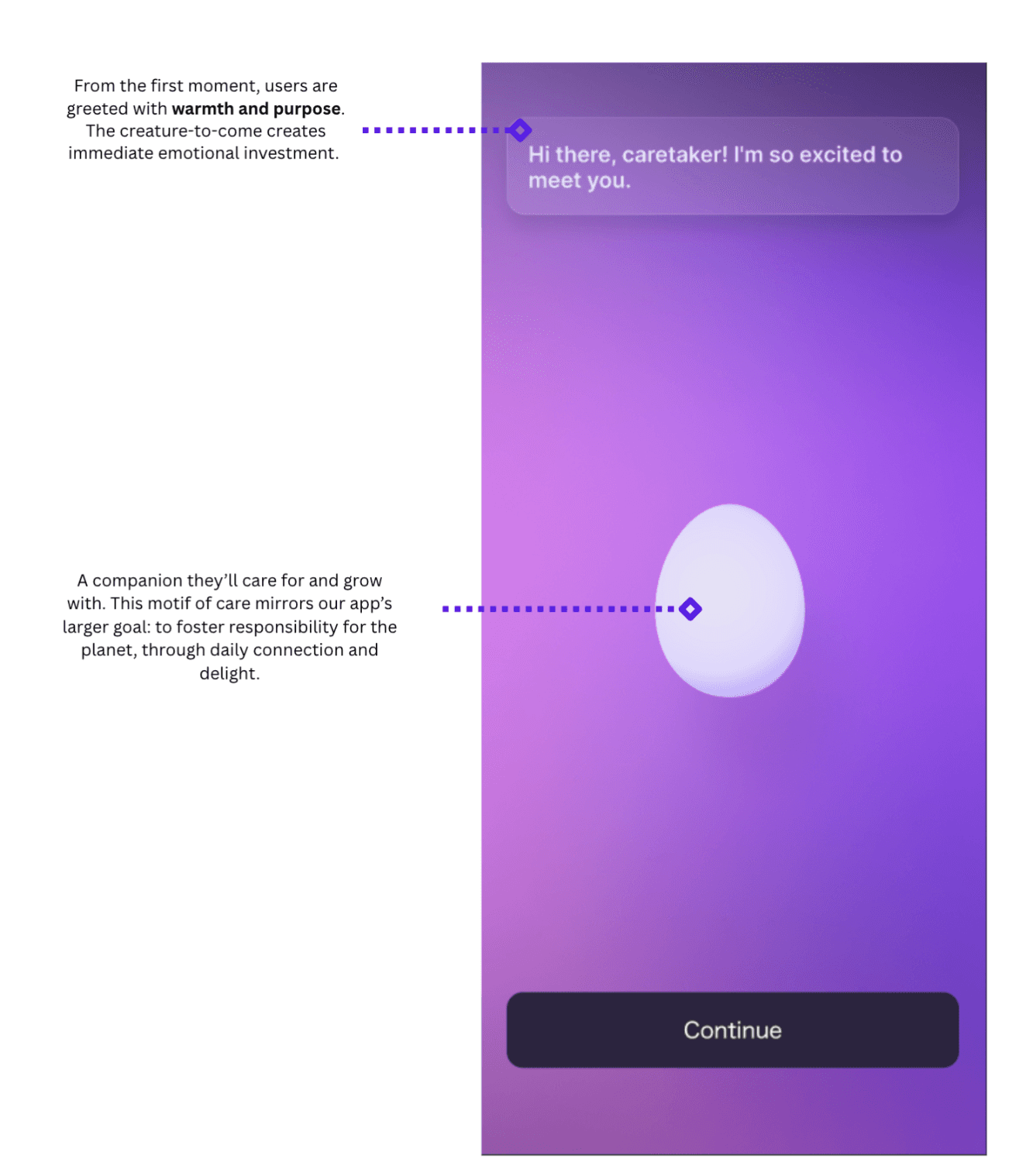
I proposed a story-driven onboarding flow with a character guide and interactive quiz. I wanted users to feel emotionally connected before they even saw the interface.
Problem :
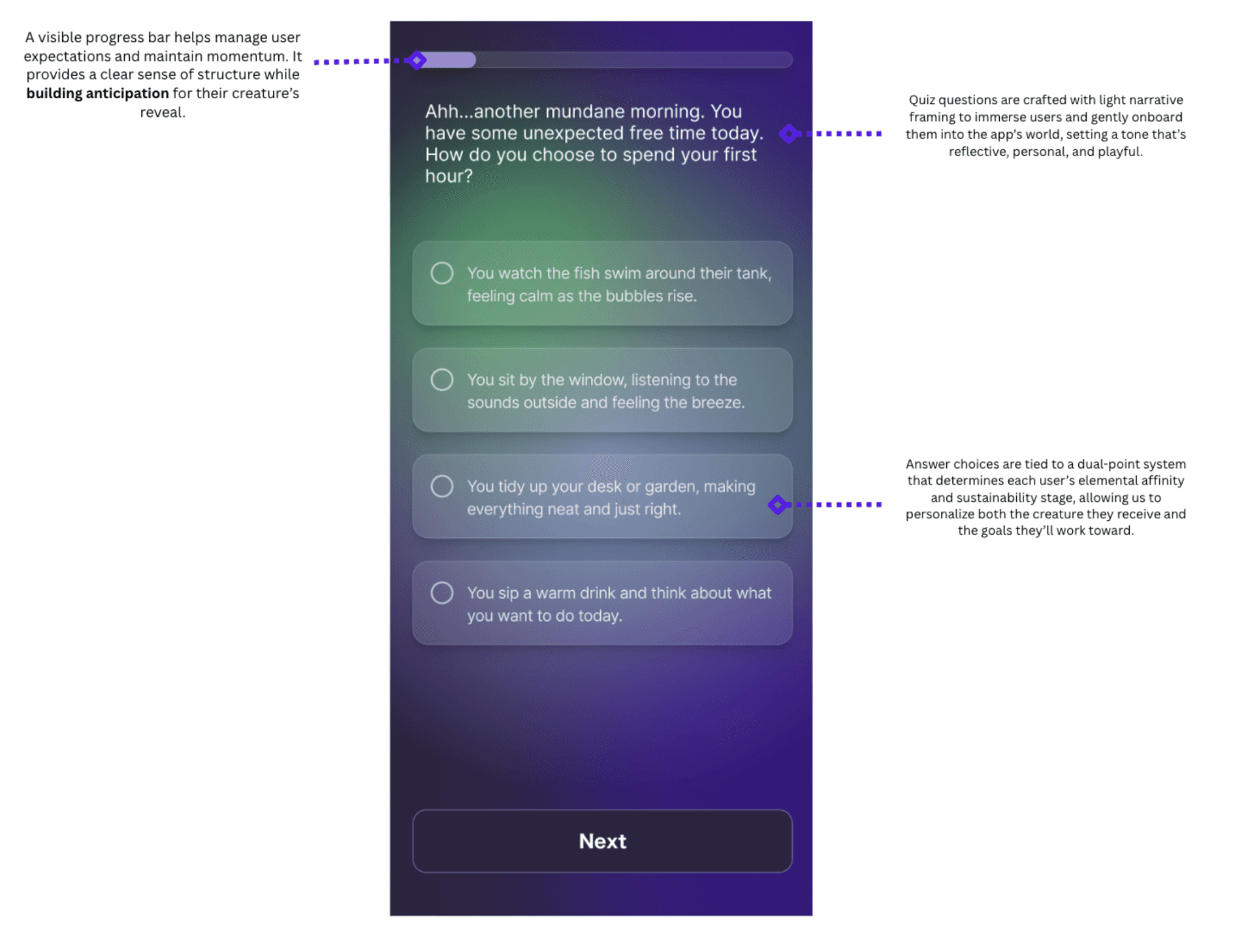
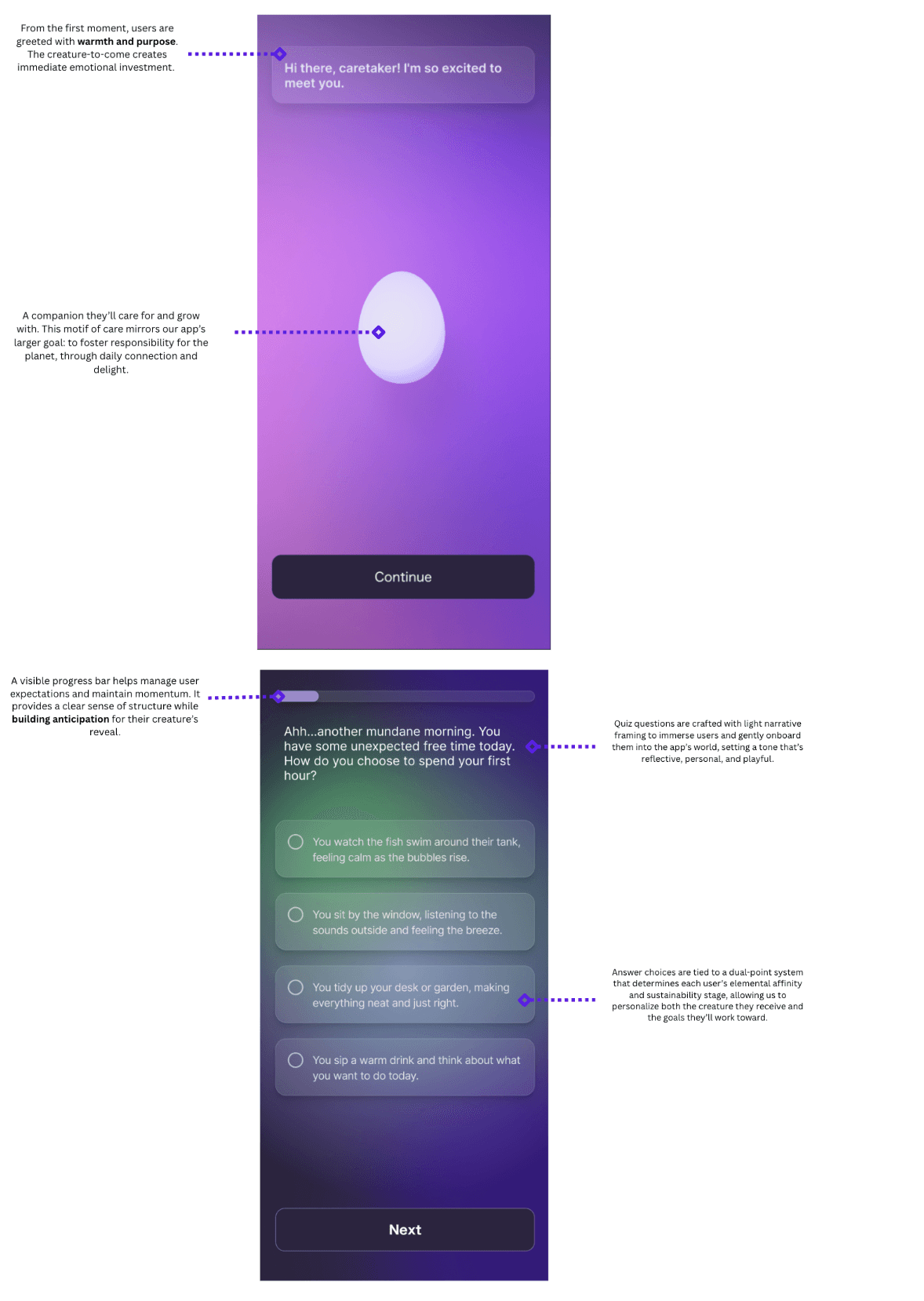
AI‑Generated Reports: I conceptualized and designed an AI‑driven progress report that interprets user behavior and offers personalized insights at a glance. This feature reinforces the Planet Pal's adaptive intelligence and long‑term engagement.
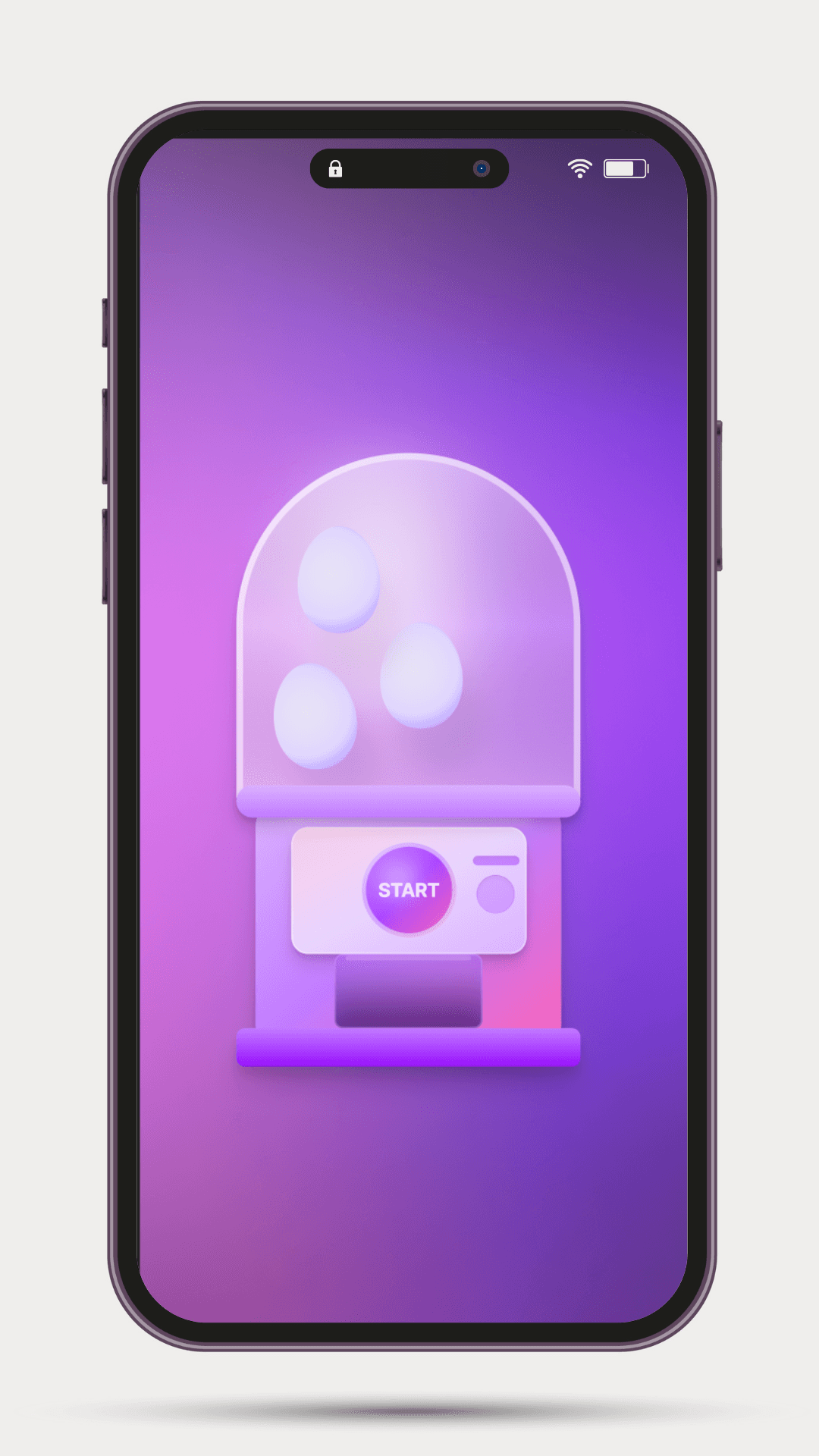
Interactive Prototype
Problem :
Problem :
Problem :
Problem :
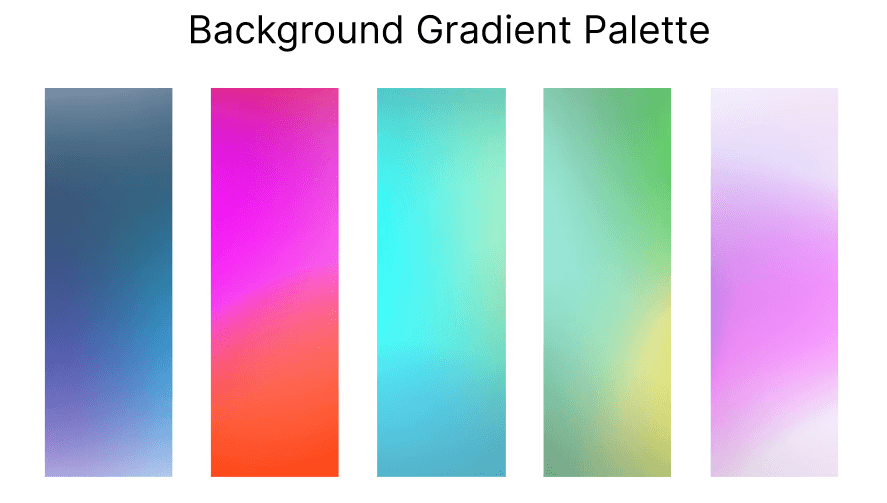
Visual direction
FINAL PROTOTYPE
Lessons Learned
Problem :
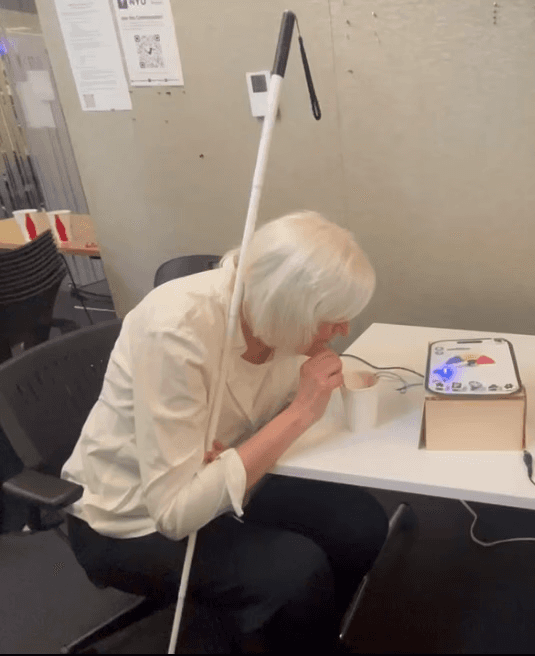
In just 24 hours, I learned how to blend emotionally resonant storytelling with actionable sustainability guidance. It required quickly balancing charm with functionality. This sprint deepened my understanding of human-centered design under pressure and showed me how to intentionally use narrative to support behavioral change. Integrating tools like Manus AI and Lovable gave me hands-on insight into embedding AI meaningfully and reminded me how effective AI can be when paired with heart.
Improvement Opportunities
Due to the time constraints of the sprint, we relied heavily on secondary research and fast iteration. If given more time, I’d lead targeted user interviews and usability testing sessions to better understand how different personality types respond to the app’s onboarding, pacing, and tone. I’d also love to expand our feature set to include a community system that encourages peer accountability and connection. Additionally, I proposed (and would love to build) an AI-integrated AR trash-scanning tool to help users visualize and reduce waste in real time to transform sustainability into something playful, trackable, and shareable.
More Projects
UX Design
Planet Pals
A mobile app that monitors and tracks users’ daily habits related to waste, energy use, and consumption.
Role:
UX Designer
Team:
Jackie Nam Minami Matsumoto Sneha Yalavarti
Timeline:
6 weeks
Tools:
Figma Arduino
Figma Arduino
Figma Arduino
Overview
Overview
Overview
Challenge
Our team was challenged to design an AI-powered mobile app that helps users make more sustainable lifestyle choices, not by overwhelming them with data, but by offering personalized guidance. The experience needed to clearly demonstrate how AI could interpret user behavior, evolve recommendations over time, and motivate long-term environmental impact.
goals & success metrics
We recognized a crucial gap between users’ intent to live sustainably and their ability to act on it. Environmental responsibility often feels overwhelming, abstract, or disconnected from daily life. To bridge that, we turned to models like Duolingo and Tamagotchi → tools that succeed by being fun, emotionally resonant, and focused on small, repeatable action.
Solution
Planet Pals transforms sustainability into a personal quest. Users begin by taking a personality quiz that determines their elemental companion, a gamified character tied to one of four global threats: fire, air, land, or water. To nurture their creature, users complete small, sustainable actions tailored to their own habits and lifestyle. With AI-driven progress tracking, adaptive task suggestions, and monthly insight reports, the app helps users see—and feel—the long-term impact of their choices.
PROCESS

Approach & Prioritization
With only 24 hours to bring Planet Pals to life, our team had to prioritize the essentials. We aligned early on the importance of emotional resonance, ease of use, and narrative continuity. This meant designing a working user flow—onboarding, task tracking, and reward systems—while also building a playful world users would actually want to return to.
As the UX writer and narrative strategist, I helped shape:
Onboarding & User Flow: We prioritized functionality that could complete one full loop of the experience, from quiz → creature → tasks → progress. This ensured the prototype felt cohesive and complete.
Narrative Design: I recommended a story-forward onboarding experience to build emotional connection early. Our elemental quiz was written to reinforce both theme and personality.
Visual Tone & Characters: Personalization was core to our idea, so we invested time into unique character designs that felt charming and companionable.
These priorities helped us strike a balance between clarity and charm, and ensured that even in a 24-hour sprint, Planet Pals could feel polished, purposeful, and full of heart.
Key Design Decisions
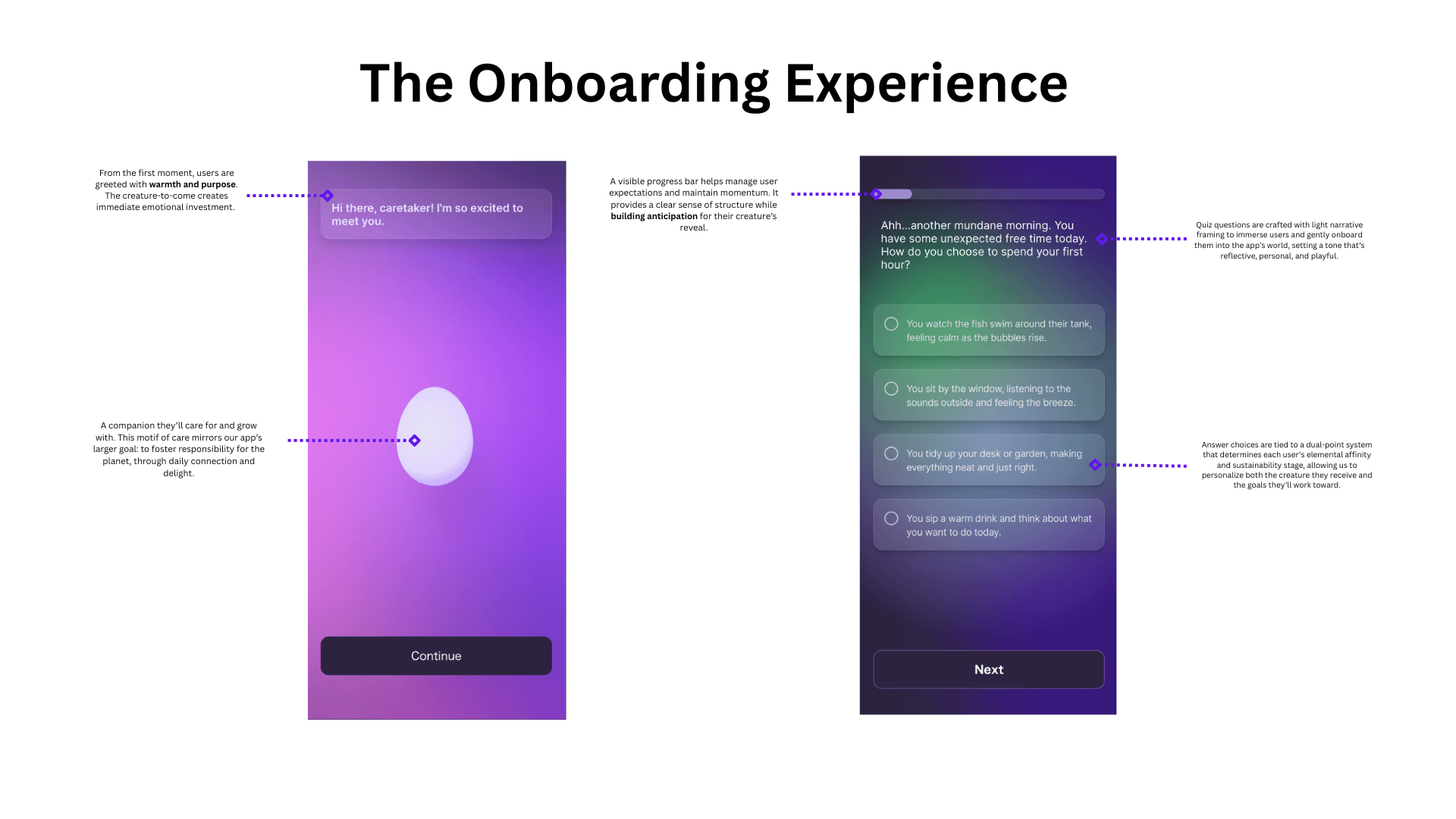
AI‑Generated Reports: I conceptualized and designed an AI‑driven progress report that interprets user behavior and offers personalized insights at a glance. This feature reinforces the Planet Pal's adaptive intelligence and long‑term engagement.
Interactive Prototype
Visual direction
Copy & Quiz Flow
annotated pictures work here
Copy samples inside UI (via annotated screens)
A few onboarding quiz Q&As or UI interactions
Use captions to say what you were aiming for emotionally or tonally.
“I wanted the copy to sound curious and kind, like a friend guiding you through a story.”
INSIGHT
Replace this with Figma embed
Problem :
Problem :
testingg
Problem :
Problem :
Problem :
Problem :
Lessons Learned
In just 24 hours, I learned how to blend emotionally resonant storytelling with actionable sustainability guidance. It required quickly balancing charm with functionality. This sprint deepened my understanding of human-centered design under pressure and showed me how to intentionally use narrative to support behavioral change. Integrating tools like Manus AI and Lovable gave me hands-on insight into embedding AI meaningfully and reminded me how effective AI can be when paired with heart.
Problem :
Improvement Opportunities
Improvement Opportunities
Due to the time constraints of the sprint, we relied heavily on secondary research and fast iteration. If given more time, I’d lead targeted user interviews and usability testing sessions to better understand how different personality types respond to the app’s onboarding, pacing, and tone. I’d also love to expand our feature set to include a community system that encourages peer accountability and connection. Additionally, I proposed (and would love to build) an AI-integrated AR trash-scanning tool to help users visualize and reduce waste in real time to transform sustainability into something playful, trackable, and shareable.
More Projects
Role:
UX Designer
Team:
Jackie Nam Minami Matsumoto Sneha Yalavarti
Client :
Figma Figma Make
Timeline:
6 weeks
Tools:
Figma Arduino
UX Design
Planet Pals
A mobile app that monitors and tracks users’ daily habits related to waste, energy use, and consumption.
Role:
UX Designer
Team:
Jackie Nam Minami Matsumoto Sneha Yalavarti
Timeline:
24 Hours
Tools:
Figma Figma Make
Figma Figma Make
Figma Figma Make
Overview
Overview
Overview
Challenge
Our team was challenged to design an AI-powered mobile app that helps users make more sustainable lifestyle choices, not by overwhelming them with data, but by offering personalized guidance. The experience needed to clearly demonstrate how AI could interpret user behavior, evolve recommendations over time, and motivate long-term environmental impact.
INSIGHT
We recognized a crucial gap between users’ intent to live sustainably and their ability to act on it. Environmental responsibility often feels overwhelming, abstract, or disconnected from daily life. To bridge that, we turned to models like Duolingo and Tamagotchi → tools that succeed by being fun, emotionally resonant, and focused on small, repeatable action.
Solution
Planet Pals transforms sustainability into a personal quest. Users begin by taking a personality quiz that determines their elemental companion, a gamified character tied to one of four global threats: fire, air, land, or water. To nurture their creature, users complete small, sustainable actions tailored to their own habits and lifestyle. With AI-driven progress tracking, adaptive task suggestions, and monthly insight reports, the app helps users see—and feel—the long-term impact of their choices.
PROCESS
Approach & Prioritization
With only 24 hours to bring Planet Pals to life, our team had to prioritize the essentials. We aligned early on the importance of emotional resonance, ease of use, and narrative continuity. This meant designing a working user flow—onboarding, task tracking, and reward systems—while also building a playful world users would actually want to return to.
As the UX writer and narrative strategist, I helped shape:
Onboarding & User Flow: We prioritized functionality that could complete one full loop of the experience, from quiz → creature → tasks → progress. This ensured the prototype felt cohesive and complete.
Narrative Design: I recommended a story-forward onboarding experience to build emotional connection early. Our elemental quiz was written to reinforce both theme and personality.
Visual Tone & Characters: Personalization was core to our idea, so we invested time into unique character designs that felt charming and companionable.
These priorities helped us strike a balance between clarity and charm, and ensured that even in a 24-hour sprint, Planet Pals could feel polished, purposeful, and full of heart.
Problem :
Problem :
Problem :
Problem :
Key Design Decisions
I proposed a story-driven onboarding flow with a character guide and interactive quiz. I wanted users to feel emotionally connected before they even saw the interface.
Problem :
AI‑Generated Reports: I conceptualized and designed an AI‑driven progress report that interprets user behavior and offers personalized insights at a glance. This feature reinforces the Planet Pal's adaptive intelligence and long‑term engagement.
Interactive Prototype
Problem :
Problem :
Problem :
Problem :
Visual direction
FINAL PROTOTYPE
Lessons Learned
Problem :
In just 24 hours, I learned how to blend emotionally resonant storytelling with actionable sustainability guidance. It required quickly balancing charm with functionality. This sprint deepened my understanding of human-centered design under pressure and showed me how to intentionally use narrative to support behavioral change. Integrating tools like Manus AI and Lovable gave me hands-on insight into embedding AI meaningfully and reminded me how effective AI can be when paired with heart.
Improvement Opportunities
Due to the time constraints of the sprint, we relied heavily on secondary research and fast iteration. If given more time, I’d lead targeted user interviews and usability testing sessions to better understand how different personality types respond to the app’s onboarding, pacing, and tone. I’d also love to expand our feature set to include a community system that encourages peer accountability and connection. Additionally, I proposed (and would love to build) an AI-integrated AR trash-scanning tool to help users visualize and reduce waste in real time to transform sustainability into something playful, trackable, and shareable.
More Projects
UX Design
Planet Pals
A mobile app that monitors and tracks users’ daily habits related to waste, energy use, and consumption.
Role:
UX Designer
Team:
Jackie Nam Minami Matsumoto Sneha Yalavarti
Timeline:
6 weeks
Tools:
Figma Arduino
Figma Arduino
Figma Arduino
Overview
Overview
Overview
Challenge
Our team was challenged to design an AI-powered mobile app that helps users make more sustainable lifestyle choices, not by overwhelming them with data, but by offering personalized guidance. The experience needed to clearly demonstrate how AI could interpret user behavior, evolve recommendations over time, and motivate long-term environmental impact.
goals & success metrics
We recognized a crucial gap between users’ intent to live sustainably and their ability to act on it. Environmental responsibility often feels overwhelming, abstract, or disconnected from daily life. To bridge that, we turned to models like Duolingo and Tamagotchi → tools that succeed by being fun, emotionally resonant, and focused on small, repeatable action.
Solution
Planet Pals transforms sustainability into a personal quest. Users begin by taking a personality quiz that determines their elemental companion, a gamified character tied to one of four global threats: fire, air, land, or water. To nurture their creature, users complete small, sustainable actions tailored to their own habits and lifestyle. With AI-driven progress tracking, adaptive task suggestions, and monthly insight reports, the app helps users see—and feel—the long-term impact of their choices.
PROCESS
Approach & Prioritization
With only 24 hours to bring Planet Pals to life, our team had to prioritize the essentials. We aligned early on the importance of emotional resonance, ease of use, and narrative continuity. This meant designing a working user flow—onboarding, task tracking, and reward systems—while also building a playful world users would actually want to return to.
As the UX writer and narrative strategist, I helped shape:
Onboarding & User Flow: We prioritized functionality that could complete one full loop of the experience, from quiz → creature → tasks → progress. This ensured the prototype felt cohesive and complete.
Narrative Design: I recommended a story-forward onboarding experience to build emotional connection early. Our elemental quiz was written to reinforce both theme and personality.
Visual Tone & Characters: Personalization was core to our idea, so we invested time into unique character designs that felt charming and companionable.
These priorities helped us strike a balance between clarity and charm, and ensured that even in a 24-hour sprint, Planet Pals could feel polished, purposeful, and full of heart.
Key Design Decisions
AI‑Generated Reports: I conceptualized and designed an AI‑driven progress report that interprets user behavior and offers personalized insights at a glance. This feature reinforces the Planet Pal's adaptive intelligence and long‑term engagement.
Interactive Prototype
Visual direction
Copy & Quiz Flow
annotated pictures work here
Copy samples inside UI (via annotated screens)
A few onboarding quiz Q&As or UI interactions
Use captions to say what you were aiming for emotionally or tonally.
“I wanted the copy to sound curious and kind, like a friend guiding you through a story.”
INSIGHT
Replace this with Figma embed
Problem :
Problem :
testingg
Problem :
Problem :
Problem :
Problem :
Lessons Learned
In just 24 hours, I learned how to blend emotionally resonant storytelling with actionable sustainability guidance. It required quickly balancing charm with functionality. This sprint deepened my understanding of human-centered design under pressure and showed me how to intentionally use narrative to support behavioral change. Integrating tools like Manus AI and Lovable gave me hands-on insight into embedding AI meaningfully and reminded me how effective AI can be when paired with heart.
Problem :
Improvement Opportunities
Improvement Opportunities
Due to the time constraints of the sprint, we relied heavily on secondary research and fast iteration. If given more time, I’d lead targeted user interviews and usability testing sessions to better understand how different personality types respond to the app’s onboarding, pacing, and tone. I’d also love to expand our feature set to include a community system that encourages peer accountability and connection. Additionally, I proposed (and would love to build) an AI-integrated AR trash-scanning tool to help users visualize and reduce waste in real time to transform sustainability into something playful, trackable, and shareable.
More Projects
Role:
UX Designer
Team:
Jackie Nam Minami Matsumoto Sneha Yalavarti
Client :
Figma Figma Make
Timeline:
6 weeks
Tools:
Figma Arduino
UX Design
Planet Pals
A mobile app that monitors and tracks users’ daily habits related to waste, energy use, and consumption.
Role:
UX Designer
Team:
Jackie Nam Minami Matsumoto Sneha Yalavarti
Timeline:
24 Hours
Tools:
Figma Figma Make
Figma Figma Make
Figma Figma Make
Overview
Overview
Overview
Challenge
Our team was challenged to design an AI-powered mobile app that helps users make more sustainable lifestyle choices, not by overwhelming them with data, but by offering personalized guidance. The experience needed to clearly demonstrate how AI could interpret user behavior, evolve recommendations over time, and motivate long-term environmental impact.
INSIGHT
We recognized a crucial gap between users’ intent to live sustainably and their ability to act on it. Environmental responsibility often feels overwhelming, abstract, or disconnected from daily life. To bridge that, we turned to models like Duolingo and Tamagotchi → tools that succeed by being fun, emotionally resonant, and focused on small, repeatable action.
Solution
Planet Pals transforms sustainability into a personal quest. Users begin by taking a personality quiz that determines their elemental companion, a gamified character tied to one of four global threats: fire, air, land, or water. To nurture their creature, users complete small, sustainable actions tailored to their own habits and lifestyle. With AI-driven progress tracking, adaptive task suggestions, and monthly insight reports, the app helps users see—and feel—the long-term impact of their choices.
PROCESS
Approach & Prioritization
With only 24 hours to bring Planet Pals to life, our team had to prioritize the essentials. We aligned early on the importance of emotional resonance, ease of use, and narrative continuity. This meant designing a working user flow—onboarding, task tracking, and reward systems—while also building a playful world users would actually want to return to.
As the UX writer and narrative strategist, I helped shape:
Onboarding & User Flow: We prioritized functionality that could complete one full loop of the experience, from quiz → creature → tasks → progress. This ensured the prototype felt cohesive and complete.
Narrative Design: I recommended a story-forward onboarding experience to build emotional connection early. Our elemental quiz was written to reinforce both theme and personality.
Visual Tone & Characters: Personalization was core to our idea, so we invested time into unique character designs that felt charming and companionable.
These priorities helped us strike a balance between clarity and charm, and ensured that even in a 24-hour sprint, Planet Pals could feel polished, purposeful, and full of heart.
Problem :
Problem :
Problem :
Problem :
Key Design Decisions
I proposed a story-driven onboarding flow with a character guide and interactive quiz. I wanted users to feel emotionally connected before they even saw the interface.
Problem :
AI‑Generated Reports: I conceptualized and designed an AI‑driven progress report that interprets user behavior and offers personalized insights at a glance. This feature reinforces the Planet Pal's adaptive intelligence and long‑term engagement.
Interactive Prototype
Problem :
Problem :
Problem :
Problem :
Visual direction
FINAL PROTOTYPE
Lessons Learned
Problem :
In just 24 hours, I learned how to blend emotionally resonant storytelling with actionable sustainability guidance. It required quickly balancing charm with functionality. This sprint deepened my understanding of human-centered design under pressure and showed me how to intentionally use narrative to support behavioral change. Integrating tools like Manus AI and Lovable gave me hands-on insight into embedding AI meaningfully and reminded me how effective AI can be when paired with heart.
Improvement Opportunities
Due to the time constraints of the sprint, we relied heavily on secondary research and fast iteration. If given more time, I’d lead targeted user interviews and usability testing sessions to better understand how different personality types respond to the app’s onboarding, pacing, and tone. I’d also love to expand our feature set to include a community system that encourages peer accountability and connection. Additionally, I proposed (and would love to build) an AI-integrated AR trash-scanning tool to help users visualize and reduce waste in real time to transform sustainability into something playful, trackable, and shareable.
More Projects
UX Design
Planet Pals
A mobile app that monitors and tracks users’ daily habits related to waste, energy use, and consumption.
Role:
UX Designer
Team:
Jackie Nam Minami Matsumoto Sneha Yalavarti
Timeline:
6 weeks
Tools:
Figma Arduino
Figma Arduino
Figma Arduino
Overview
Overview
Overview
Challenge
Our team was challenged to design an AI-powered mobile app that helps users make more sustainable lifestyle choices, not by overwhelming them with data, but by offering personalized guidance. The experience needed to clearly demonstrate how AI could interpret user behavior, evolve recommendations over time, and motivate long-term environmental impact.
goals & success metrics
We recognized a crucial gap between users’ intent to live sustainably and their ability to act on it. Environmental responsibility often feels overwhelming, abstract, or disconnected from daily life. To bridge that, we turned to models like Duolingo and Tamagotchi → tools that succeed by being fun, emotionally resonant, and focused on small, repeatable action.
Solution
Planet Pals transforms sustainability into a personal quest. Users begin by taking a personality quiz that determines their elemental companion, a gamified character tied to one of four global threats: fire, air, land, or water. To nurture their creature, users complete small, sustainable actions tailored to their own habits and lifestyle. With AI-driven progress tracking, adaptive task suggestions, and monthly insight reports, the app helps users see—and feel—the long-term impact of their choices.
PROCESS
Approach & Prioritization
With only 24 hours to bring Planet Pals to life, our team had to prioritize the essentials. We aligned early on the importance of emotional resonance, ease of use, and narrative continuity. This meant designing a working user flow—onboarding, task tracking, and reward systems—while also building a playful world users would actually want to return to.
As the UX writer and narrative strategist, I helped shape:
Onboarding & User Flow: We prioritized functionality that could complete one full loop of the experience, from quiz → creature → tasks → progress. This ensured the prototype felt cohesive and complete.
Narrative Design: I recommended a story-forward onboarding experience to build emotional connection early. Our elemental quiz was written to reinforce both theme and personality.
Visual Tone & Characters: Personalization was core to our idea, so we invested time into unique character designs that felt charming and companionable.
These priorities helped us strike a balance between clarity and charm, and ensured that even in a 24-hour sprint, Planet Pals could feel polished, purposeful, and full of heart.
Key Design Decisions
AI‑Generated Reports: I conceptualized and designed an AI‑driven progress report that interprets user behavior and offers personalized insights at a glance. This feature reinforces the Planet Pal's adaptive intelligence and long‑term engagement.
Interactive Prototype
Visual direction
Copy & Quiz Flow
annotated pictures work here
Copy samples inside UI (via annotated screens)
A few onboarding quiz Q&As or UI interactions
Use captions to say what you were aiming for emotionally or tonally.
“I wanted the copy to sound curious and kind, like a friend guiding you through a story.”
INSIGHT
Replace this with Figma embed
Problem :
Problem :
testingg
Problem :
Problem :
Problem :
Problem :
Lessons Learned
In just 24 hours, I learned how to blend emotionally resonant storytelling with actionable sustainability guidance. It required quickly balancing charm with functionality. This sprint deepened my understanding of human-centered design under pressure and showed me how to intentionally use narrative to support behavioral change. Integrating tools like Manus AI and Lovable gave me hands-on insight into embedding AI meaningfully and reminded me how effective AI can be when paired with heart.
Problem :
Improvement Opportunities
Improvement Opportunities
Due to the time constraints of the sprint, we relied heavily on secondary research and fast iteration. If given more time, I’d lead targeted user interviews and usability testing sessions to better understand how different personality types respond to the app’s onboarding, pacing, and tone. I’d also love to expand our feature set to include a community system that encourages peer accountability and connection. Additionally, I proposed (and would love to build) an AI-integrated AR trash-scanning tool to help users visualize and reduce waste in real time to transform sustainability into something playful, trackable, and shareable.
More Projects
Role:
UX Designer
Team:
Jackie Nam Minami Matsumoto Sneha Yalavarti
Client :
Figma Figma Make
Timeline:
6 weeks
Tools:
Figma Arduino